HOAOF / Strategy / PLO AOF
PLO AOF Key Spots — 14 Close Decisions on SD·FD Boards
The most common flops in PLO AOF (all-in or fold) are SD·FD boards, short for straight-draw and flush-draw boards: unpaired flops where no straight or flush is complete yet (60% of all flops). This article collects the decisions on those boards where intuition is least reliable, answered with exact GTO results.
- Basis and terms
- Part 1. Worked examples — K♥ 9♠ 7♥
- Part 2. Boundary decisions — the one factor that splits a hand
- App availability
Basis and terms
- Game: WPL PLO AOF · 10bb · 4-max (CO · BTN · SB · BB) · the 3-card flop is dealt first, then each player shoves or folds.
- Each EV is measured against folding: +1.72bb means the call earns 1.72bb more on average than folding, and a negative number means fold. Folding is the baseline, and it already costs the BB its posted 1bb and the SB its 0.5bb (dead money); that is what “fold = −1bb / −0.5bb” in the chart headers means (CO and BTN have posted nothing, so their fold is 0).
- For a call, required equity = chips still to put in ÷ final pot after rake, and EV = final pot × (equity − required equity).
- Equity is your share of the pot at showdown against the GTO range that actually shoves, with the earlier folds taken into account.
- SD · FD
- SD = straight draw · FD = flush draw. A nut FD draws to the highest possible flush; 2nd-nut (2nd), 3rd and 4th FDs draw to the next-highest flushes; a low FD is 4th-nut or worse.
- SD board · SD+FD board
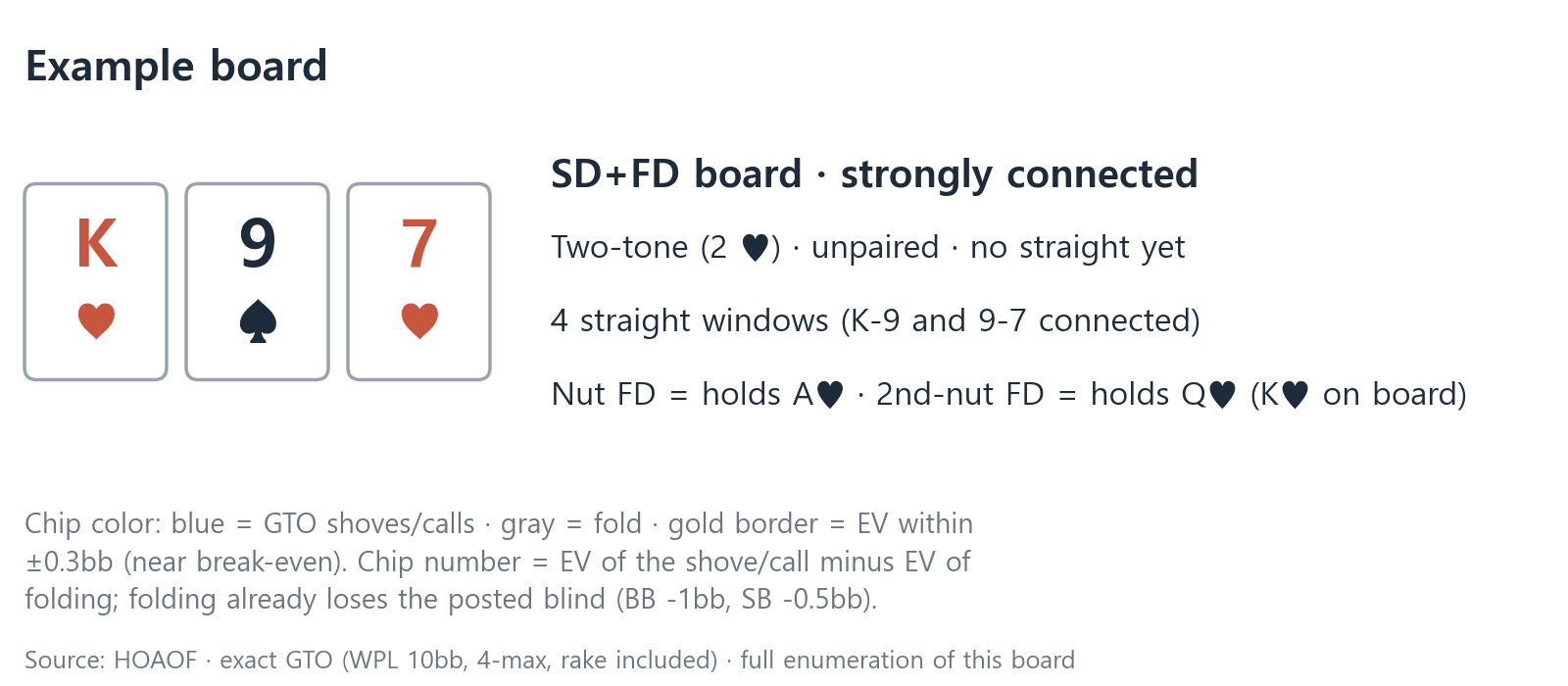
- SD board = rainbow flop with straight draws only (23.7% of flops) · SD+FD board = two-tone flop with straight and flush draws (36.2%) · together the SD·FD boards (60%). Part 2 covers all 666 two-tone SD+FD flop types.
- Weakly · moderately · strongly connected
- 0–1 · 2 · 3+ straight windows that use two board cards (K♥ 9♠ 7♥ has 4, so it is strongly connected)
- Gutshot
- Inside straight draw (4 outs or fewer)
- OESD · wrap
- Open-ended straight draw (5–8 outs) · straight draw with 9+ outs (17+ is a big wrap)
Part 1. Worked examples — K♥ 9♠ 7♥
K♥ 9♠ 7♥ allows both straight draws and a heart flush draw, a typical SD+FD board. In each of the six questions below, one detail (seat, number of players, draw rank) flips the answer, so intuition alone often gets it wrong.
Q1. Bottom set (77): call in a 3-way pot?
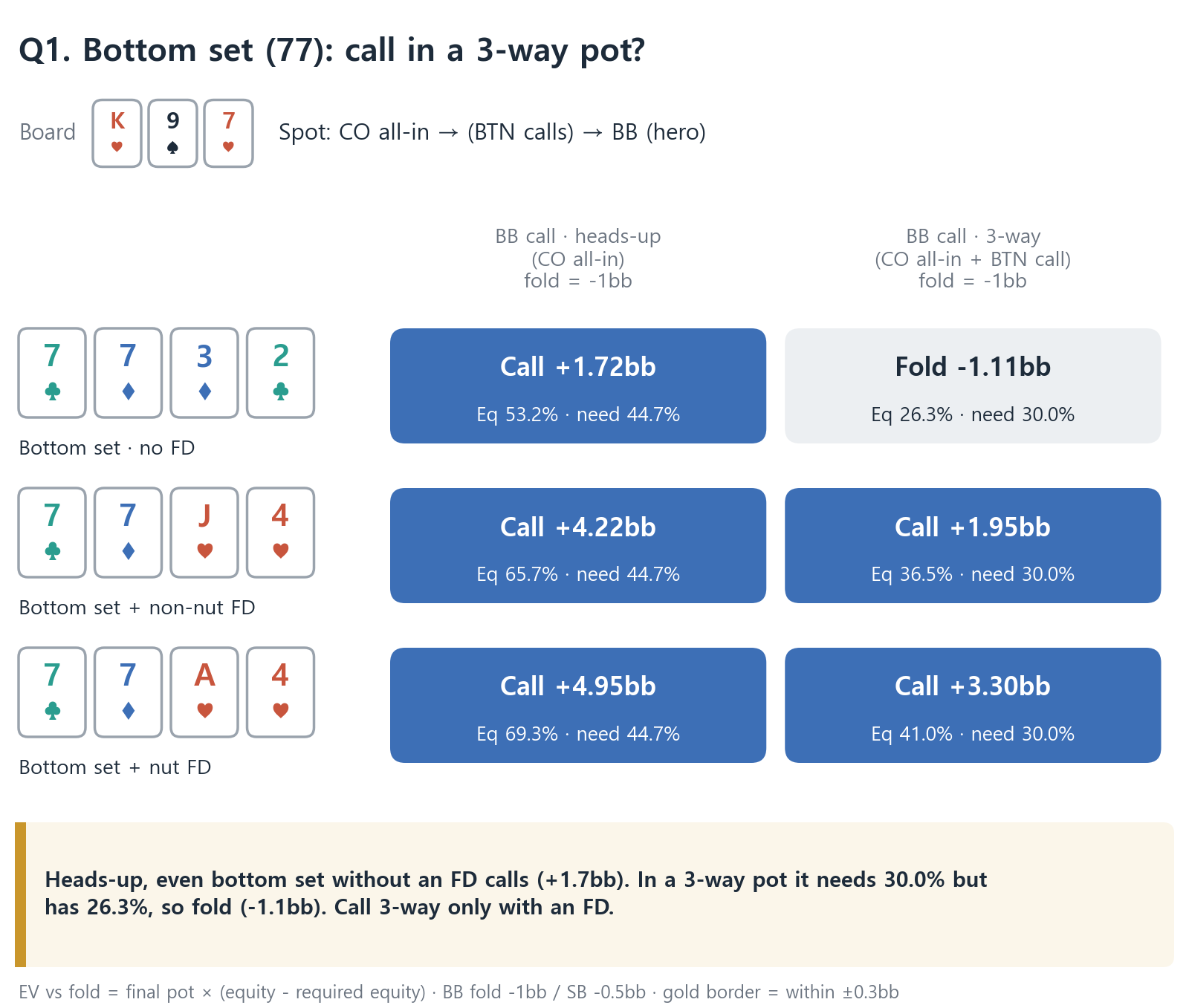
Heads-up, even bottom set with no FD calls (+1.72bb). In a 3-way pot it needs 30.0% but has 26.3%, so fold (−1.11bb). Call 3-way only with an FD.
Q2. 2nd-nut FD: call a CO all-in?
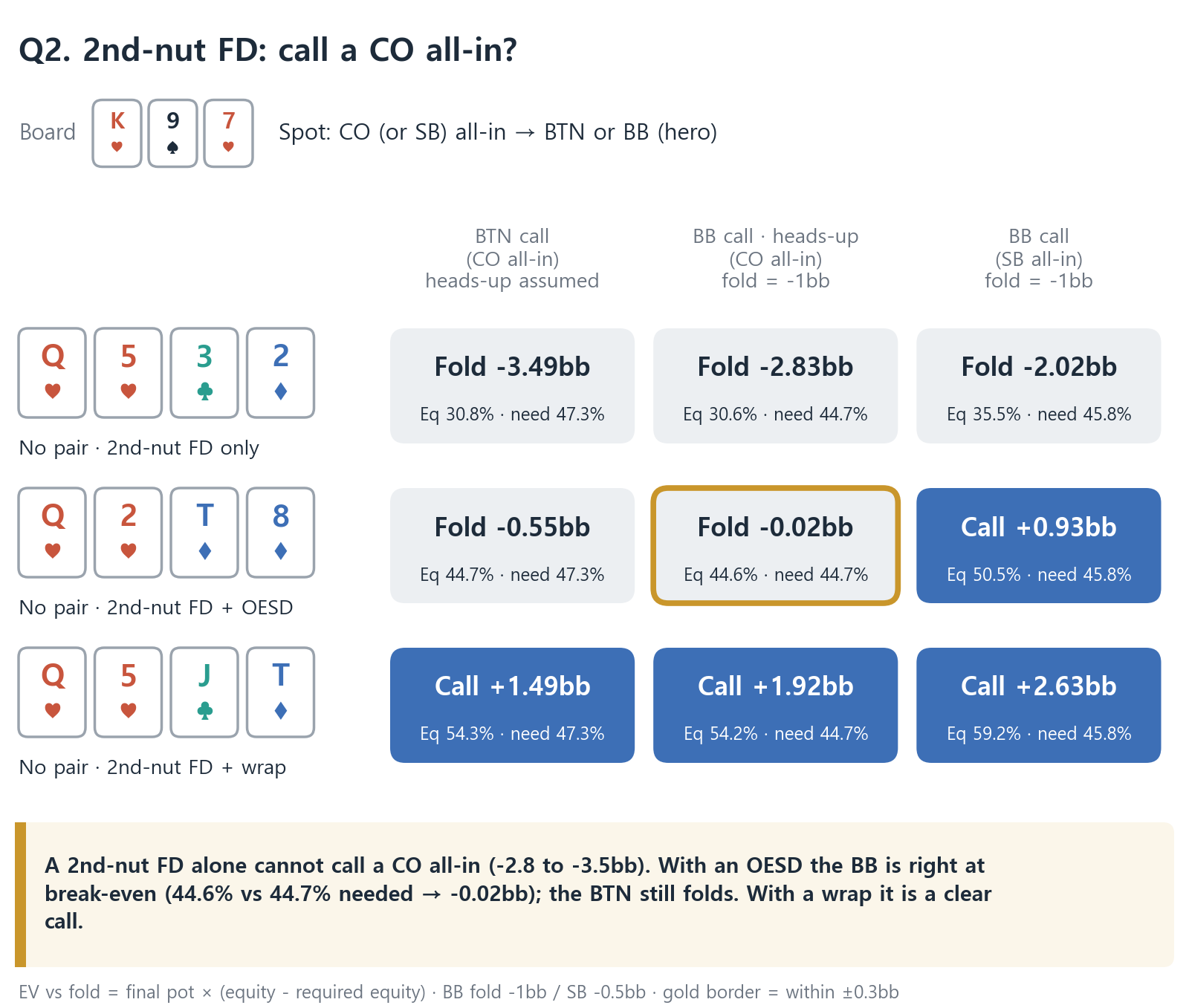
A 2nd-nut FD alone cannot call a CO all-in. With an OESD the BB is right at break-even (44.6% vs 44.7% needed → −0.02bb) and the BTN still folds. With a wrap it is a clear call.
Q3. Top two pair (K9): call a CO all-in?
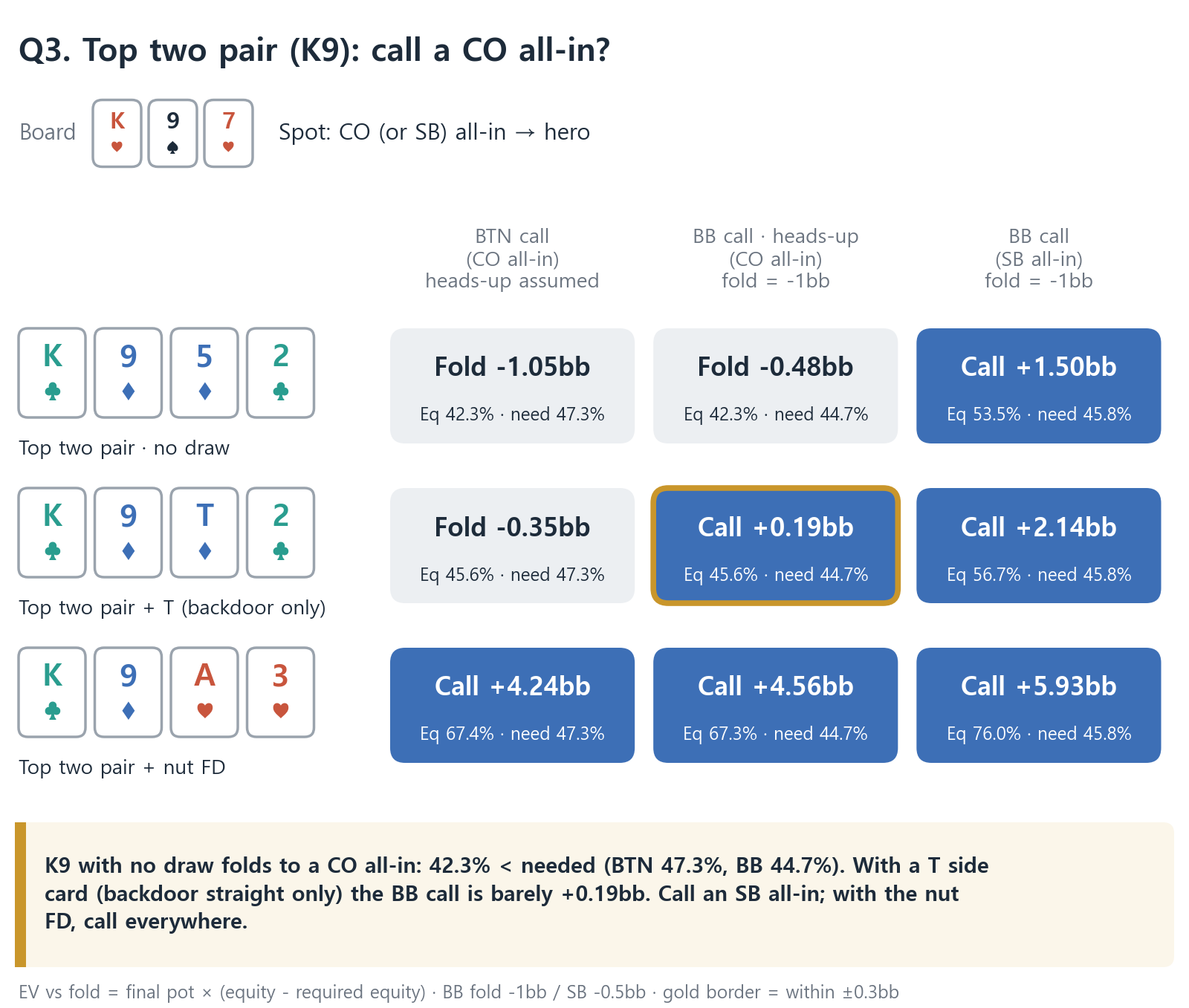
K9 with no draw folds: 42.3% against the CO shoving range, below the 47.3% (BTN) and 44.7% (BB) needed. Call an SB all-in; with the nut FD, call everywhere.
Q4. AA with no draw: open shove?
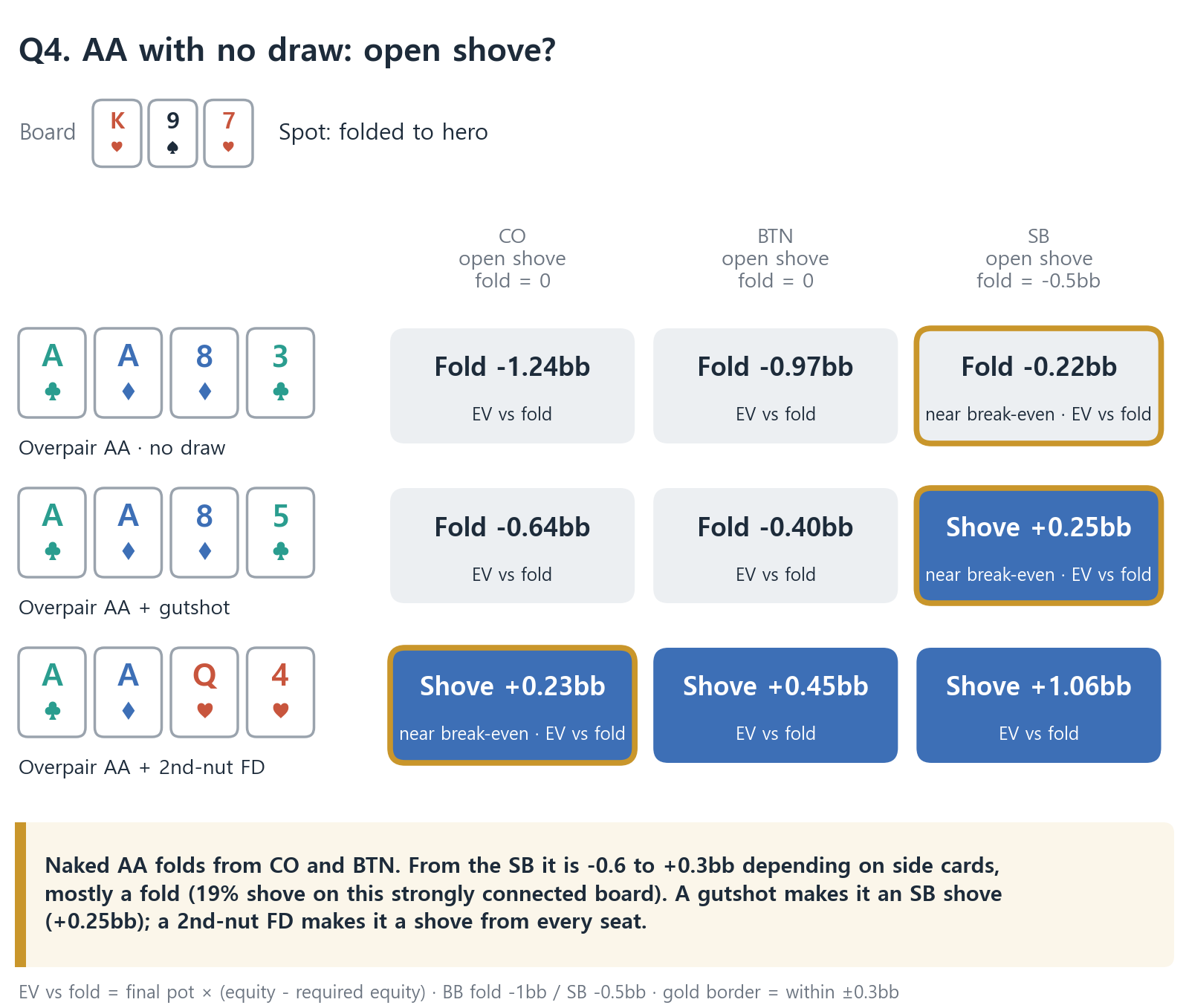
Fold from CO and BTN. From the SB it is −0.6 to +0.3bb depending on side cards, mostly a fold (19% shove on this strongly connected board). A gutshot makes it a shove only from the SB (+0.25bb; CO and BTN still fold); a 2nd-nut FD makes it a shove from every seat.
Q5. Nut FD: better 3-way than heads-up?
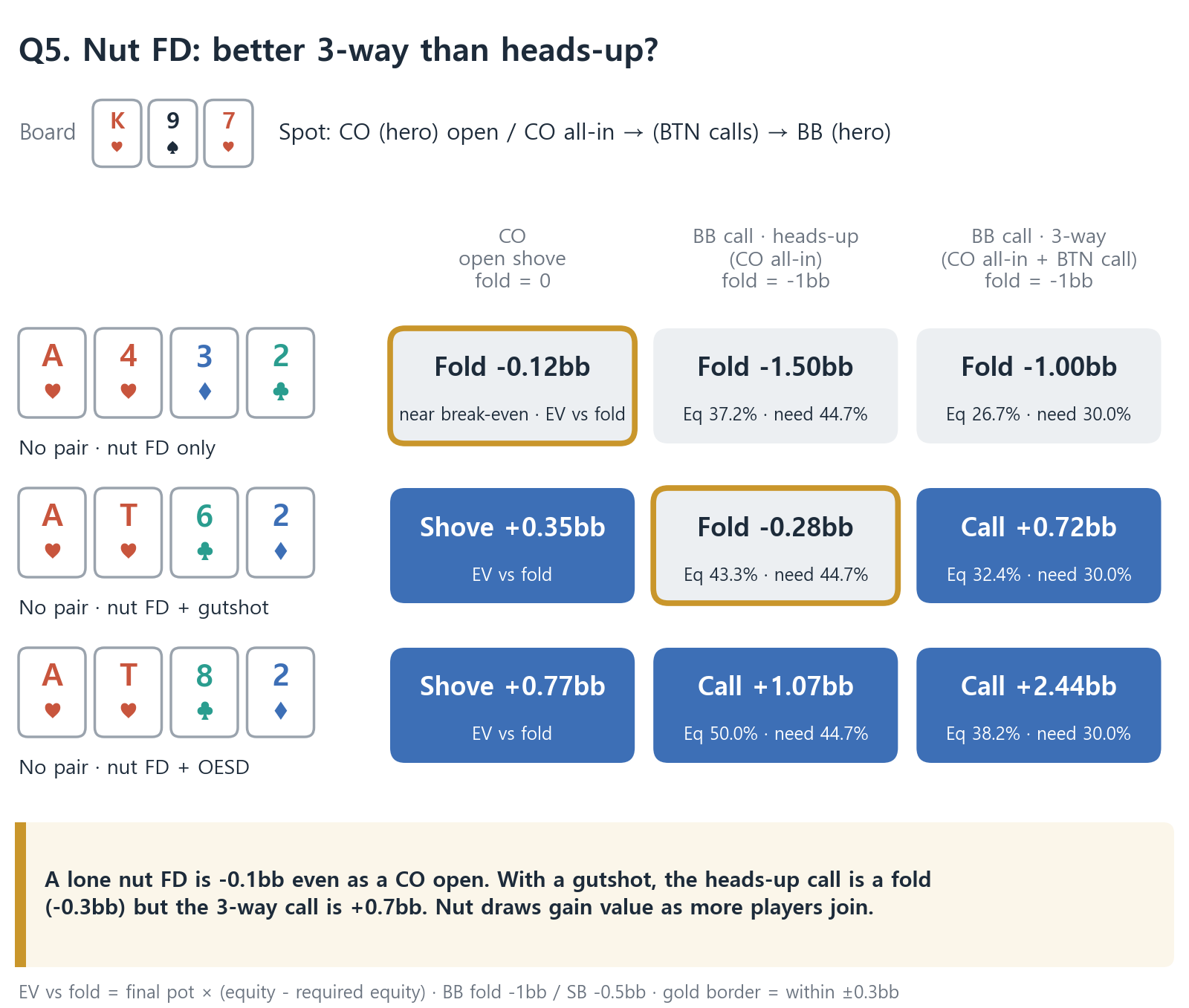
Nut FD + gutshot is −0.28bb (fold) as a heads-up call but +0.72bb (call) in a 3-way pot. Nut draws gain value as more players join.
Q6. Top pair + FD: the answer depends on the seat
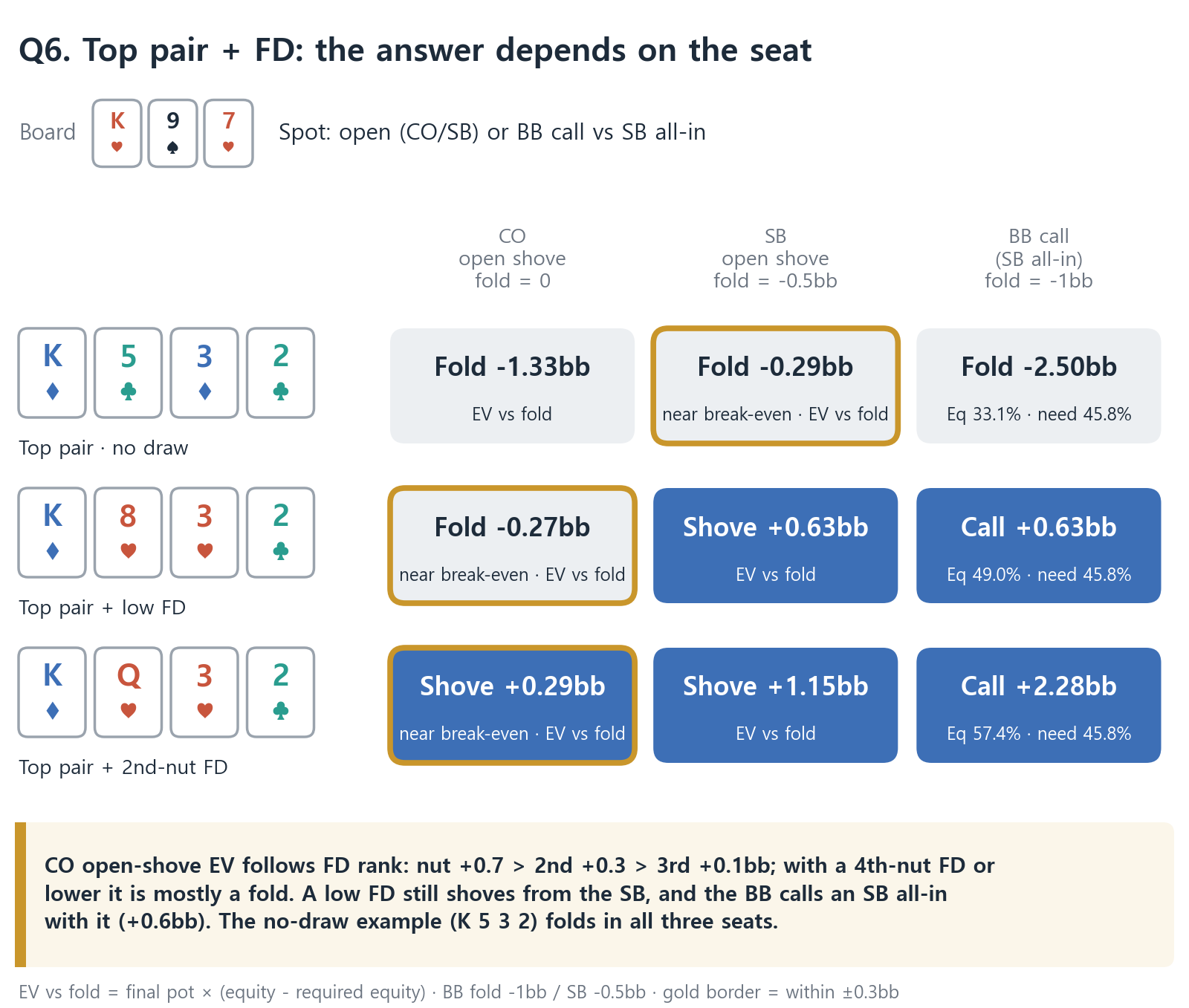
CO open-shove EV follows FD rank (nut +0.7 > 2nd +0.3 > 3rd +0.1bb); with a 4th-nut FD or lower it is mostly a fold. On this board even a low FD shoves from the SB, and the BB calls an SB all-in with it (both +0.63bb with the example K♦ 8♥ 3♥ 2♣).
Part 2. Boundary decisions — the one factor that splits a hand
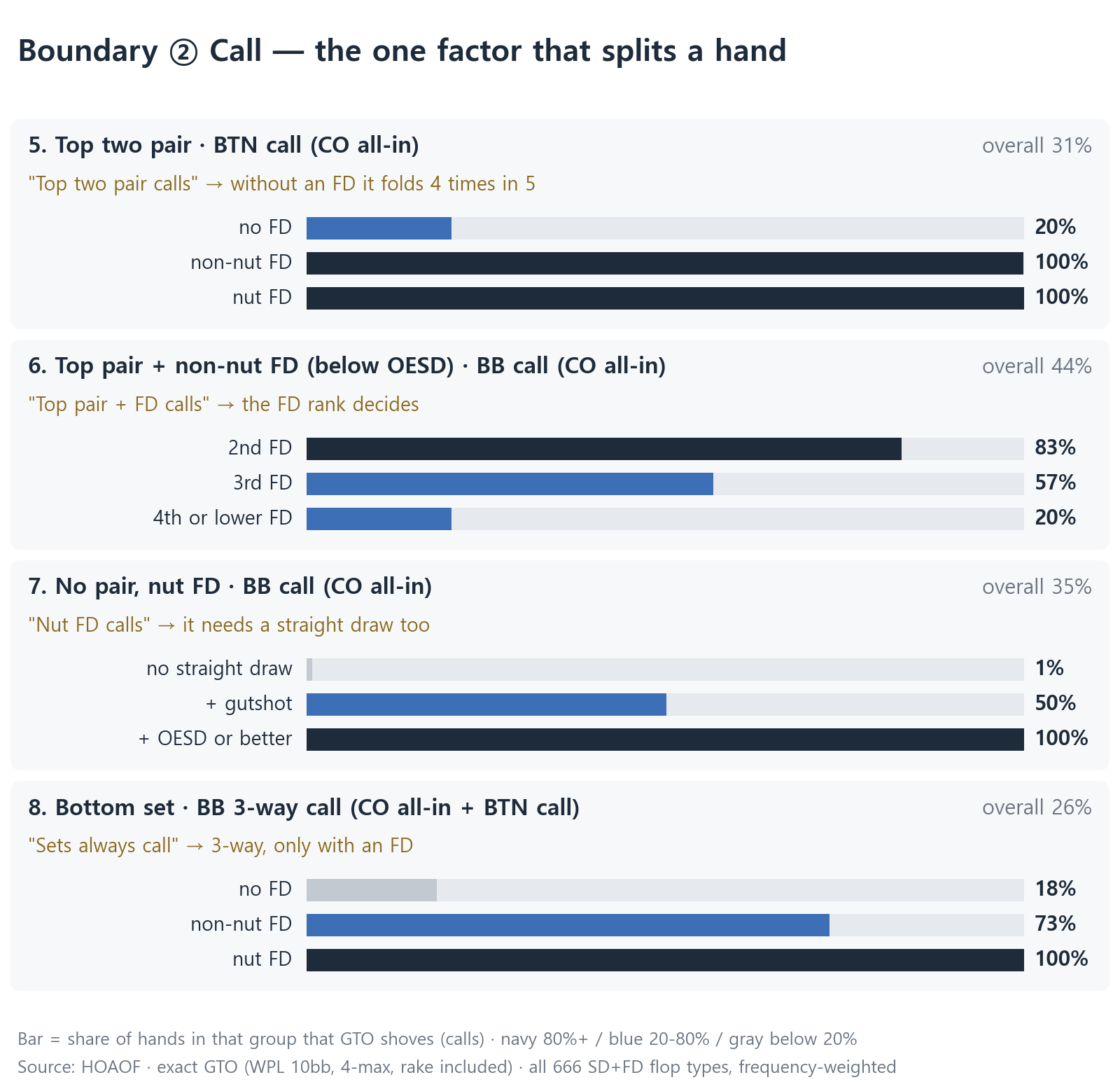
When GTO shoves or calls a hand 20–80% of the time, it is mostly not a coin-flip mix: one factor inside the same hand class separates shoves from folds (across all 666 two-tone SD+FD flop types).
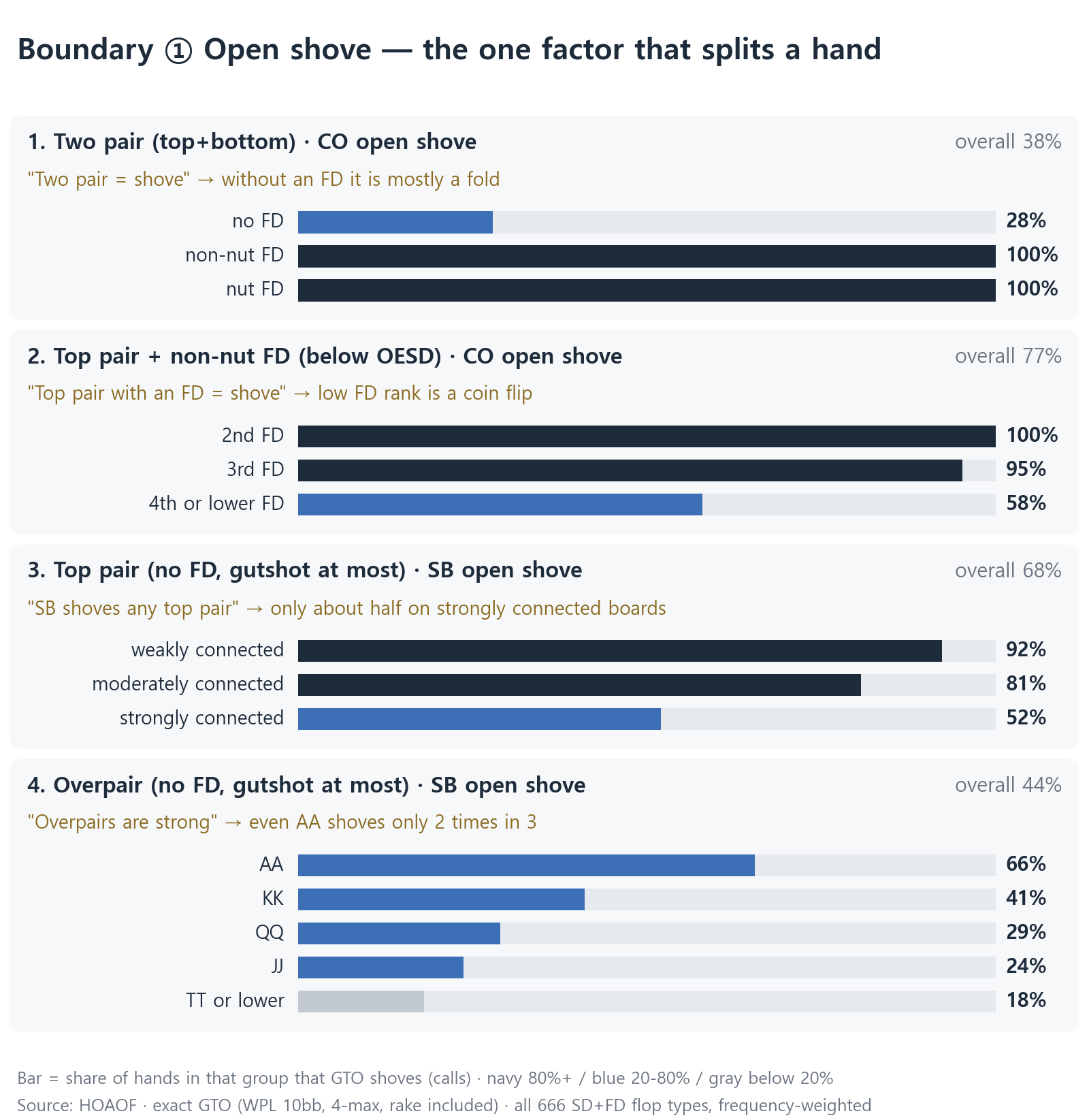
Four factors that decide the boundary
- Flush draw or not — without an FD, two pair and sets shove or call only 18–28% of the time (top+bottom two pair CO open 28%, top two pair BTN call 20%, bottom set 3-way call 18%). With the nut FD all three are 100%; a non-nut FD is mostly a shove or call too (only bottom set 3-way stays at 73%).
- FD rank — with a non-nut FD, the call rate drops sharply with each step down in rank (top pair + non-nut FD with a gutshot at most, BB calling a CO all-in: 2nd 83% → 3rd 57% → 4th or lower 20%).
- Straight draw — with no pair and the nut FD, the BB calls a CO all-in 1% of the time with no straight draw, 50% with a gutshot and 100% with an OESD or better.
- Board connection and pair height — top pair with no FD and a gutshot at most shoves from the SB less often as the board gets more connected (weakly 92% → strongly 52%), and an overpair shoves less often the lower it is (AA 66% → TT or lower 18%). AA with no straight draw at all drops further: on a strongly connected board like K♥ 9♠ 7♥, AA shoves from the SB only 19% of the time (Q4).
App availability
The HOAOF app available today is NLH AOF. The PLO AOF version is in preparation; when it launches you will be able to check the equity and decision for your exact hand and board.
EV is the expected value of the model (exact GTO under WPL rules), not a guarantee of winnings.