HOAOF / Strategy
AOF Strategy: GTO Ranges, ATS, FTA and Expected Value
All-in or fold offers two actions, but the decision depends on more than your cards. This guide explains the NLH AOF model through positions, opponent ranges and a recorded app example.
- A range belongs to a situation
- GTO and adjustments to opponents
- Understand ATS and FTA
- Position and earlier actions
- A real KTs example
- Stack, rake and bonus assumptions
- A practical analysis checklist
A range belongs to a situation
A CO opening range and a BB calling range against CO are different strategies. A 169-hand chart groups NLH hands into pairs, suited hands and offsuit hands. These cells carry different weights: 6 combinations per pair, 4 per suited hand and 12 per offsuit hand. Counting colored cells is not the same as measuring a range percentage.
GTO and adjustments to opponents
HOAOF uses stored approximate GTO baseline strategies, not a guarantee of an exact equilibrium in every situation. Its four-player showdown calculation includes a three-player approximation. Exploitative analysis changes the opponent model when there is evidence of different behavior. Two statistics cannot uniquely identify every hand in an opponent’s range.
Understand ATS and FTA
ATS measures opening all-ins when no earlier player has gone all-in. In a four-player table, these opportunities occur at CO, BTN and SB. Calls and BB walks are not opening steals. FTA measures folds when facing at least one earlier all-in. FTA 80% means approximately 20% calls among those opportunities, not a fold rate across all dealt hands.
HUD definitions and sample sizes may differ. The GTO figures shown by HOAOF are opportunity-weighted model statistics with everyone using the baseline for the chosen table setting. Custom inputs select precomputed representative ranges at interval midpoints; small changes within one interval may give the same result.
Position and earlier actions
Action starts at CO in four-player NLH AOF, BTN with three players and SB heads-up. On the button, a CO fold creates an opening situation; a CO all-in creates a calling situation. Equity against a random hand does not replace equity against the range consistent with those actions. Players still to act also affect the decision.
A real KTs example
The recorded example uses WPL 10bb, four players, Hero SB with KTs, CO all-in with ATS 40 / FTA 60, BTN fold and BB on the GTO baseline.
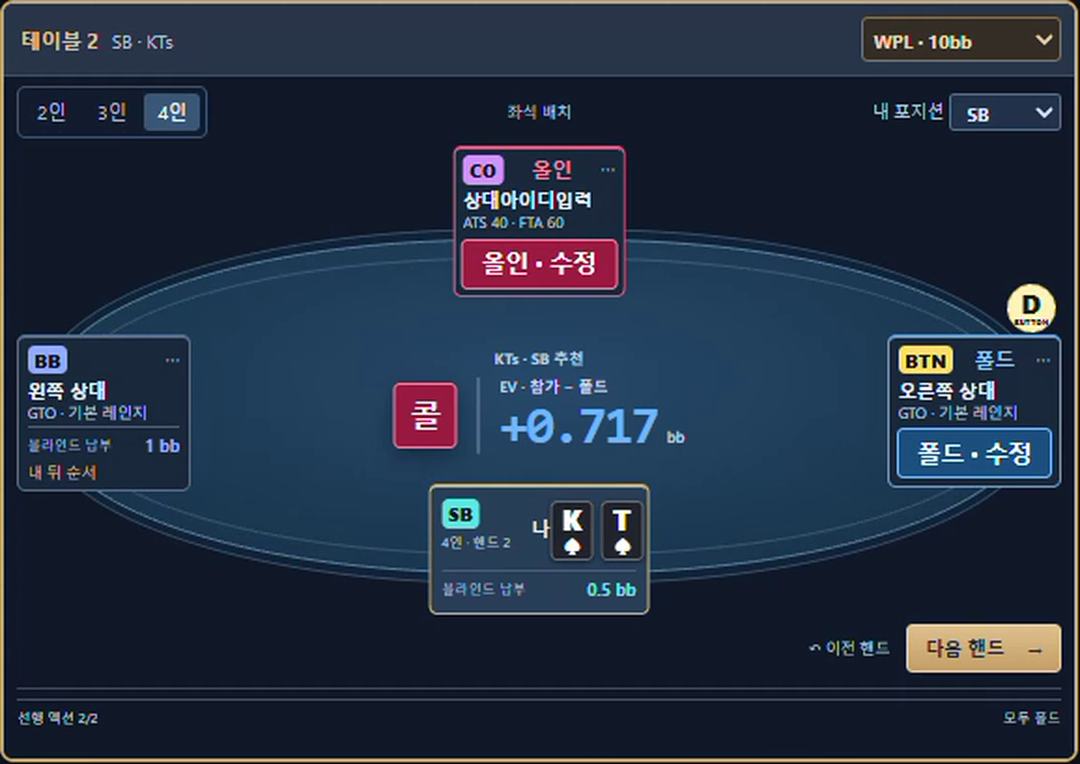
Play − Fold = +0.717bb means playing has 0.717bb more expected value than folding in this model. It is neither realized profit nor proof that the absolute EV of playing is positive.
Stack, rake and bonus assumptions
The current app separates WPL 10bb with a straight-flush bonus from CoinPoker 8bb without that bonus, and includes platform-specific rake assumptions. These describe the app configuration, not a promise about an operator’s latest rules. Changing bonus conditions changes the calculation.
Money added to the contested pot can change both strategy and EV. Do not confuse it with money already paid directly to a player. HOAOF’s CoinPoker four-player splash mode uses supported precomputed strategy sets; custom ATS/FTA ranges are not applied in that mode.
A practical analysis checklist
- Match the platform, stack, active seats and position.
- Check the definition and sample behind opponent statistics.
- Enter earlier actions in order.
- Select your hand and compare playing with folding.
- Review assumptions before judging a decision from one result.
NLH AOF is currently available; PLO AOF is in preparation. Do not transfer NLH ranges directly to PLO. Expected value describes the model and does not guarantee winnings.